Climate Action Now (CAN)
CAN Summit 2022 - Energy - Danni Barnes, National Energy Action
217 views
Energy session
Stockport CAN Summit 2022
View transcript
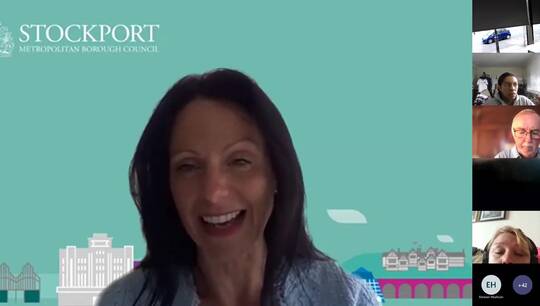
Yeah, all right. Thanks very much, Steven. Um, so the last of our speakers in the energy session is Danni Barnes, who is the Director of Operations at National Energy Action. And I can see Danni's ready, poised ready online. That's great. So without further ado, just let you know, National Energy Action,Uh there are national fuel poverty, charity. So over to you, Danni. Take it away. Thanks very much. I'll just wait for my slides to hopefully come up on the screen, and you know, I might have to tell me if there, there okay. They don't seem to be coming up online. Not yet, we've got success, It's coming. Come in any second now. Yes there, there . Do you have them? They're not up on mine. Crack on, fine Perfect. Um, So, yes, thank you for the introduction. Somebody put their hand up? Don't worry about that, just ignore that, right okay. Um, so yes. So I'm Danni. I come from National Energy Action, We're National Fuel Poverty and Energy Efficiency Charity. We've worked, I don't think the presentation is working for people online I think that might be the issue. So apologies there, I'll try, let me just exit and stop presenting I'll just try re sharing it. So Danni, if there's any use Liz has just bolted out the door to see to see what's going on, so just try it one more time and then I think if you could, If you could start oh it coming back online, yeah, they can see them now. So I think we're okay, sorry about the technical difficulties, but I think we're back on track. Thanks Danni, crack on. No worries, so yes apologies for that. So, yes I'm from National Energy we're National Fuel Poverty Charity and we work across England, Wales and Northern Ireland, and we're been in existence for over 40 years. I do have to kind of put out an apology here and now, I tend to bring the mood down when I start to talk about this, obviously particularly against the backdrop of the crisis. It's quite a difficult time for a lot of our clients that we're supporting. We work across industry, so we're campaigning charity at our hearts, but we also deliver practical advice and support to householders, and we also deliver a lot of technical evaluation, so how non standard and low carbon technologies can be used to best effect to support people who might be struggling or in a low income. So I just want to talk through what is fuel poverty, for those of you that might not be familiar, around 6.5 million households living in fuel poverty it's a direct result of low incomes, high energy costs and inefficient housing. We know that this time last year that was, that figure was 4.5 million, so there's been a steep increase since the April price cap increase, and we know that's going to increase further when we get to the October increase. Um, it's worth mentioning as far as we're concerned four and a half million was already too many, but we know that we're seeing a far greater impact as we approach the winter for this year. Um, it's worth mentioning Stockport had around 12% people of people living in fuel poverty by the most recent stats, but the most recent starts are two years out of date and their predate the crisis. So the actual situation is far, far worse, so it won't have escaped anybody's attention the cost of living crisis is kind of the here and now issue, we know that inflation is a 30 year high, the cost of everything has gone up, but salaries have not gone up by the same, same amount. And we know there has actually been a cut to the welfare benefits, and as everybody can appreciate if you're dependent on welfare benefits, that will be because you are of the lowest incomes. We know that food bank use is at an all time high, with over 5,000 parcels being given out every day by the Trussell Trust. So the view of bleak It's been very miserable. Um, and sadly for our clients particularly, we're not even in the heating season, so the sun is currently shining so people don't necessarily need their heating on, when we get to the winter we know it's gonna be far harder. So just to touch on the impact, and then I do promise I will get to some of the solutions and a bit more of an uplifting view, because I appreciate a lot of the speakers have spoken very uplifting and I will get there too, I promise. So the impacts are huge spiralling household debt we're seeing a vast increase in clients coming to seek our support with debt advice and debt repayments and we seeing unsafe coping strategies. Including energy rationing, switching things off, and people may have seen Martin Lewis talk about warmth banks, And that's not a new concept actually, but we used to call them community spaces, and that's how we would like to see them branded going forward. Because there is an opportunity to use community spaces for other positive benefits around social isolation, but it is sad that people are finding that they need to go and house themselves in libraries to keep warm. The detriment to physical and mental health is very high, we know that on average at least 10,000 people each year will die simply from living in a cold home, and the impact on mental health is very, very significant. You won't want to have people around your home so you might feel isolated, and for children particularly we know there's a direct correlation between houses that might be, households that might be living in fuel poverty and the lack of educational attainment, children can't do their homework when they're shivering and they're more likely to get poorly and have to have time off from school. Danny, I'm sorry to interrupt you, it just It's still on your first slide just in case you have moved on from there. I have moved on, loads of slides, maybe if I just stop sharing, and maybe If I just circulate the slides afterwards. Do you want me to see if I can move them? Yeah, there we go, so if you just tell me next slide if you can get to the one which is titled Energy Crisis, which is a yellow box, a blue box and then another yellow and blue box. There we go, fantastic, thank you. Um, so just to talk about the energy crisis specifically in the increases, the two left hand boxes just reference the increase since Um, October 2020 we will have seen energy prices double. I just want to talk about some of the immediate support just very briefly, but I won't go into a lot of detail because I do want to move onto the kind of link with climate change. And so there has been a cost of living support package that's been announced, we know that that will only in part offset the rise that has planned for October for some households on the lowest incomes. We were welcoming of the fact that lot of the support was very much targeted at those who will be struggling the most come the winter. There was universal support for all electricity customers £400 rebate, we believe although it's still under discussion, but this will be paid a six monthly payments starting from October, and there's targeted support which is £650 for those on the lowest incomes so likely to be those on means tested benefits. There's £300 top up for those who received the winter fuel allowances principally pensioners, £150 for those list in receipt of benefits, and £150 which was previously announced, for those in urban houses branded A to D. We also know that a lot of houses, local authorities have had substantial investment in their crisis funding, so their local household support. So could you go to the next slide, please? Thank you. Um, so just in terms of the solution so fuel poverty is not inevitable and we know we have solutions to this, it's something that can actually be resolved. We have a legally binding commitment to tackle fuel poverty, which in England includes a commitment to get all properties to band C by 2030. So, just to be clear that means their energy, their EPC rating would be band C and the closer you get to A is kind of the better, more efficient your home is. But we do need strong governance, we've got a lack of government currently and so to ensure deliveries to those time frames we need to really start, to continue to hold the government to account to make sure we reach that, that's fuel poverty target. We also as everybody will appreciate, have the net zero target by 2050, I agree with all of the speakers from, from previously 2050 is far too far away, and if nothing else, the crisis has sharpened their attention on the need for driving energy efficiency here and now, it's such a critical thing, and it is the most sustainable solution to help people living in the most inefficient homes to be able to afford to heat their homes this winter. The two targets sometimes can be seen, those two policy agendas can sometimes be seen as jarring, we don't believe that they need to be, we see that they can be incredibly complimentary if you ultimately work to tackle fuel poverty and bring up all of our housing stock to a more efficient standard, that will ultimately mean that we're also secure reaching our carbon emission targets. So the two need to have kind of twin focus, so we know investment in energy efficiency is critical, we also need to apply pressure to ensure that the energy market is less complex and we able to, that customers are able to navigate the energy market and benefit from policies that are there that are intended to serve them, but are often behind the glass walls as it were. We also need to redesign our welfare system so those are entitled to benefits and support are able to access it, we know that £15 billion worth of benefits goes unclaimed and we also need greater collaboration. Working together is the only way we're going to tackle it, so there's no silver bullet, sadly I mean it's not one individual or one organisation that's going to resolve this. One of the things that we always say and perhaps this may be the wrong group to say this too, but I'm going to say it anyway and hope you see where the spirit of the phrase is coming from. We've always said it's not just about buildings and carbon It's about the individual and their home, we're talking about a huge shift in how people will need to use their heating systems, how their homes will be insulated, the types of technologies that will be fitted in homes and that requires enhanced engagement around behaviour change, how people optimise on those systems and how they can make the most of them. Because the worst case scenario would be that we apply a fit and forget approach where we go, yeah we ticked our carbon box because we put a low carbon technology into their home, but we don't engage those individuals and they end up using it wrongly or not using it at all, and therefore we exacerbate fuel poverty rather than help alleviate it. So, just on to the final slide what more can be done? Regional local agencies, we want everybody to come together and raise fuel poverty up the agenda draw out the connections between fuel poverty and other important issues obviously principally climate change. But also beyond that kind of health sector, making sure people understand how eradicating fuel poverty will also alleviate the health impacts and ease the burden on our NHS. We need to ensure that all groups have a commitment to achieving a just transition to net zero, keeping a real focus on affordably warm and low carbon homes and also promote the benefits of action. So working across multiple departments, multiple agencies from public health through to schools, through to climate change groups, local authorities, housing associations, all pulling in the same direction. That's all I wanted to say today. There is, I could probably bore you all day I'm afraid it's an incredibly busy time for our organisation as I'm sure you will appreciate, but I just wanted to give you a few headlines and I would invite you to take a look at our website because we have a lot of useful tools that you can share with your friends, communities, families, anybody that might be struggling in what is going to be an incredibly difficult, difficult year and the year, that's probably going to expand over the next two sadly. Thank you very much for your time and sorry about the presentation.